Guides
4 lessons worth learning about chimney sweep startup
A chimney sweep startup turns on certification, route density, and documented inspections, not on a copied business plan from another trade.
What to take away
- A one-van start runs a typical $9,000 to $25,000 once you count the vehicle, rods, vacuum, camera, insurance and software.
- Sweeping, inspection and repair are three service lines with three credential paths. Sell the sweep first, then add what you can certify.
- Price per flue and per inspection. Typical US first-flue rates sit around $175 to $300, with each extra flue lower.
- Route density decides survival. Ten jobs inside one zip cluster beat fifteen spread across a metro.
- Confirm licensing, insurance and tax registration with your state, your insurer and a CPA.
What it costs to start
One-time costs and recurring costs behave differently. The van and the rods get paid for once. Insurance, software, fuel and storage repeat whether or not the phone rings.
| Item | Typical US range | Type |
|---|---|---|
| Used cargo van | $6,000 to $20,000 | One-time |
| Rods, brushes, drop cloths | $400 to $900 | One-time |
| HEPA vacuum | $500 to $1,200 | One-time |
| Inspection camera | $300 to $1,500 | One-time |
| General liability insurance | $1,200 to $3,500 a year | Recurring |
| Scheduling software | $50 to $150 a month | Recurring |
| LLC filing and local permits | $50 to $500 | One-time |
| Fuel, phone, storage | $6,000 to $11,000 a year | Recurring |
Treat those as typical ranges, not quotes. Insurance and vehicle prices move by state and by driving record. Walk the chimney sweep equipment checklist before you buy, because rod length and vacuum filtration decide which flues you can service at all.
Credentials, licensing and insurance
The United States path is a sequence, not one certificate.
- Entity filed with your state, EIN in hand
- State or municipal license confirmed if your area requires one
- General liability policy active before the first paid job
- CSIA certification booked if you plan to advertise it
- Sales tax registration filed where your state taxes the work
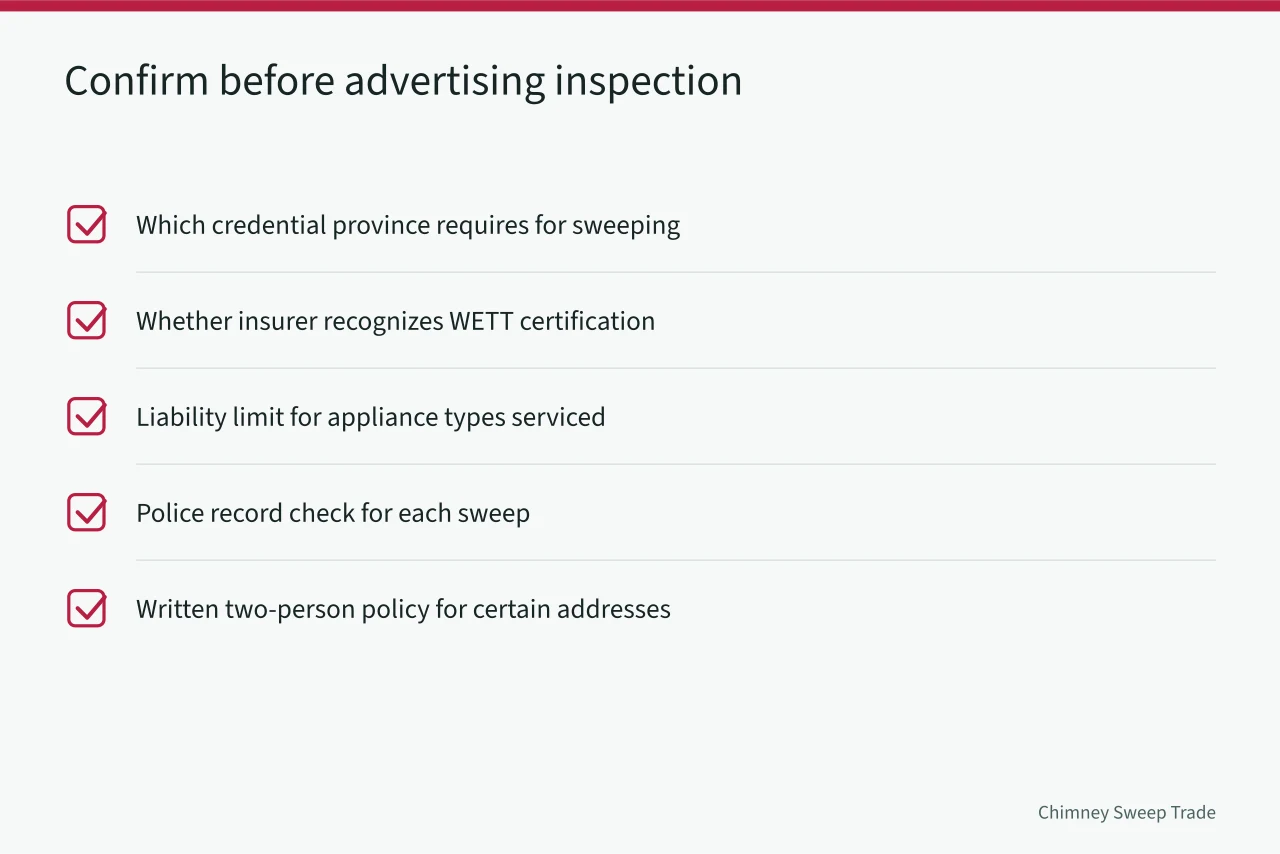
CSIA certification is voluntary in most states, and it is the credential homeowners and realtors ask about by name. Inspection work is judged against NFPA 211, the standard realtors reference when they question a chimney's condition. The federal side of registration is short; the IRS starting a business page lists the forms.
Fall protection applies on every roof. OSHA requires protection above six feet, and a steep pitch counts. Read the fall protection requirements before your first climb, not after it.
Your insurer sets the liability limit, not you. Compare quotes against the chimney sweep insurance costs and coverage breakdown so you can tell a standard limit from a paid add-on.
Pricing per flue and per inspection
Price the unit, not the visit. A flue is a unit. An appliance is a unit. A house is not.
- First flue
- typical $175 to $300.
- Each additional flue
- typical $75 to $150.
- Wood insert or freestanding stove
- add $50 to $100.
- Level 1 inspection
- typical $150 to $300. Level 2 with camera: $300 to $600.
- Repair
- quoted from the inspection, never folded into the sweep price.
Price the unit, not the visit
- Base sweep, first flue, one appliance
- Each additional flue, priced lower
- Wood insert or stove, priced above fireplace
- Inspection, quoted only by certified technician
- Repair, quoted after inspection, never bundled
Do not discount inspection to win sweeping work. It takes longer, carries more liability, and needs a credential the sweep may not hold. The pricing approach for a fair margin explains why hourly math beats a per-house quote.
Route density and the first-season plan
If a job pays P, takes S minutes on site and sits D minutes of driving from the last one, revenue per hour is P divided by (S + D). Raising D cuts hourly revenue while the price stays flat.
- Weeks 1 to 3entity, EIN, insurance, van and gear. No marketing yet.
- Weeks 4 to 6twenty practice jobs, every one timed and logged.
- Weeks 7 to 10one zip cluster, door hangers, a Google Business Profile.
- Weeks 11 to 20work the autumn peak, add inspection once certified.
- Weeks 21 to 30review revenue per working hour, then decide on a second hire.
Every job ends with a written record: what you swept, what you saw, what you did not touch. The sweep finds a concern and stops. A certified technician writes the finding. Repair is quoted from that finding, never from a verbal note.
The scheduling chimney sweep jobs without delays guide covers how to hold that route together when a customer cancels at seven in the morning.
Example: one van, one season
Illustrative figures for a solo sweep in the upper Midwest, not a forecast.
Change one input and the answer moves. Cut output to two jobs a day and revenue falls to $91,200 while fixed costs stay put. Run that arithmetic before you sign a lease.
Canada as a second market
In Canada the inspection credential is WETT certification, and provincial or municipal licensing can apply on top. Register for GST/HST once you pass the threshold and check PST in your province. Quebec adds French-language rules for consumer marketing. Treat this as secondary, not a substitute for your own regulator.