Guides
How cottage country changes chimney work in Muskoka and the Laurentians
Chimney sweep Muskoka Laurentians work runs on cottage seasons: spring opening schedules, dock and boat access, island logistics and pricing for water travel.
What to take away
- Chimney sweep Muskoka Laurentians work is seasonal, not year round: demand clusters around spring opening and the weeks before Thanksgiving.
- Spring opening schedules start once lanes dry and ice leaves the lakes, so the first sweep of the season often lands in late April or May.
- Dock and boat logistics decide whether an island cottage is worth the trip, and they belong in the quote before you launch.
- Cottage pricing models need a travel or water-access line, because a single flue rarely pays for a two-hour drive.
- Booking windows fill fast before the May long weekend, while the autumn push comes from owners closing up and renters arriving.
- Property managers and rental turnover can keep a rural route profitable between the two peaks.
Why Muskoka and the Laurentians follow a two-window season
A city sweep works all year. A cottage sweep works when the owners are there, and in Muskoka and the Laurentians that is a short window.
Cottage chimney work calendar
- Late April-JuneMain cottage work window
- September-OctoberSecond cottage work window
- WinterSnow closes lanes, ice covers water
- ThawOwners return from the city
Muskoka cottages sit on Lake Muskoka, Lake Joseph and Lake of Bays, north of Barrie and Bracebridge, reachable by boat or by a long private lane. The Laurentians run north of Montreal through Sainte-Agathe, Mont-Tremblant, Saint-Sauveur and Val-David, where many properties are second homes or short-term rentals. Lac Masson and Lac Tremblant add boat-only addresses.
Both regions share the same rhythm. Snow closes lanes, ice covers the water, and the owners stay in the city until the thaw.
That means your revenue is compressed. You may do most of a year's cottage work between late April and June, then again in September and October.
Heating patterns support the demand. Statistics Canada tracks wood heating by province, and rural Canada saw population growth through the 2021 census period, which keeps seasonal housing stock in use.
The share of Canadian households using wood heating by province is set out in the rural population growth analysis, and it explains why so many cottages still have a wood appliance to sweep.
General housing and heating data relevant to cottage service demand sits with Canadian housing statistics, useful when you are deciding which lakes to add to a route.
A second van only pays when the route has enough cottages to cover the drive each week, so map the lakes in Muskoka and the Laurentians before you commit.
Ontario and Quebec rules differ
A Muskoka operator registers in Ontario, and the province publishes a small business start guide covering registration and the paperwork a sole proprietor needs.
A Laurentians operator registers in Quebec and needs a Quebec Enterprise Number. The NEQ registration page explains how to obtain one.
Work standards differ too. Ontario sweeps answer to the Technical Standards and Safety Authority and the Office of the Fire Marshal, while Quebec sweeps work under the Régie du bâtiment du Québec.
Across both provinces, the National Fire Code of Canada and CSA Group standards shape what a compliant installation looks like. Wood Energy Technology Transfer (WETT) certification is what most insurers and homeowners ask for.
Consumer protection duties apply in every province, and the provincial consumer protection framework is a fair model for written quotes and cancellation terms.
Spring opening schedules and the first sweep of the season
Spring opening is the appointment where the owner opens the cottage, turns the water on and starts thinking about the fireplace. It is also your busiest slot.
The first sweep of the season usually waits until the lane is passable and the roof is safe. In Muskoka, that window runs from late April to mid-May on Lake Muskoka, Lake Joseph and Lake of Bays. In the Laurentians, higher elevations around Lac Tremblant and Val-David push the first sweep to late May or early June.
Build the schedule around the thaw, not the calendar. A fixed opening date in Parry Sound will not match conditions near Mont-Tremblant.
Here is how a working spring sequence looks:
Spring opening sweep sequence
- Confirm owner or manager on site
- Check lane and driveway conditions
- Inspect from ground, then roof
- Sweep flue, appliance and connector
- Check cap and spark arrestor
- Photograph and leave written report
That sequence is the same whether you are one sweep or three. What changes is the scheduling that works when travel time is measured in hours rather than minutes.
What the first visit usually finds
A cottage chimney sits idle for months. Expect animal nests, rusted caps and cracked crown mortar.
Creosote from last autumn is still there, and it has had all winter to harden. Glazed deposits take more time than a routine city sweep.
Water damage is common where a chimney passes through a cold attic. Report it, and note that a mason may be needed.
Birds and squirrels are the usual occupants. A screened cap solves most of it, and it is an easy add-on.
Cottage access: lanes, docks, boats and island properties
Access is the part of cottage work that city sweeps underestimate. A Muskoka lane can be a kilometre of gravel, sand and rock, and a Laurentians driveway can climb at an angle a loaded van will not take.
Ask three questions before quoting: how far from the road, what surface, and what happens if it rains.
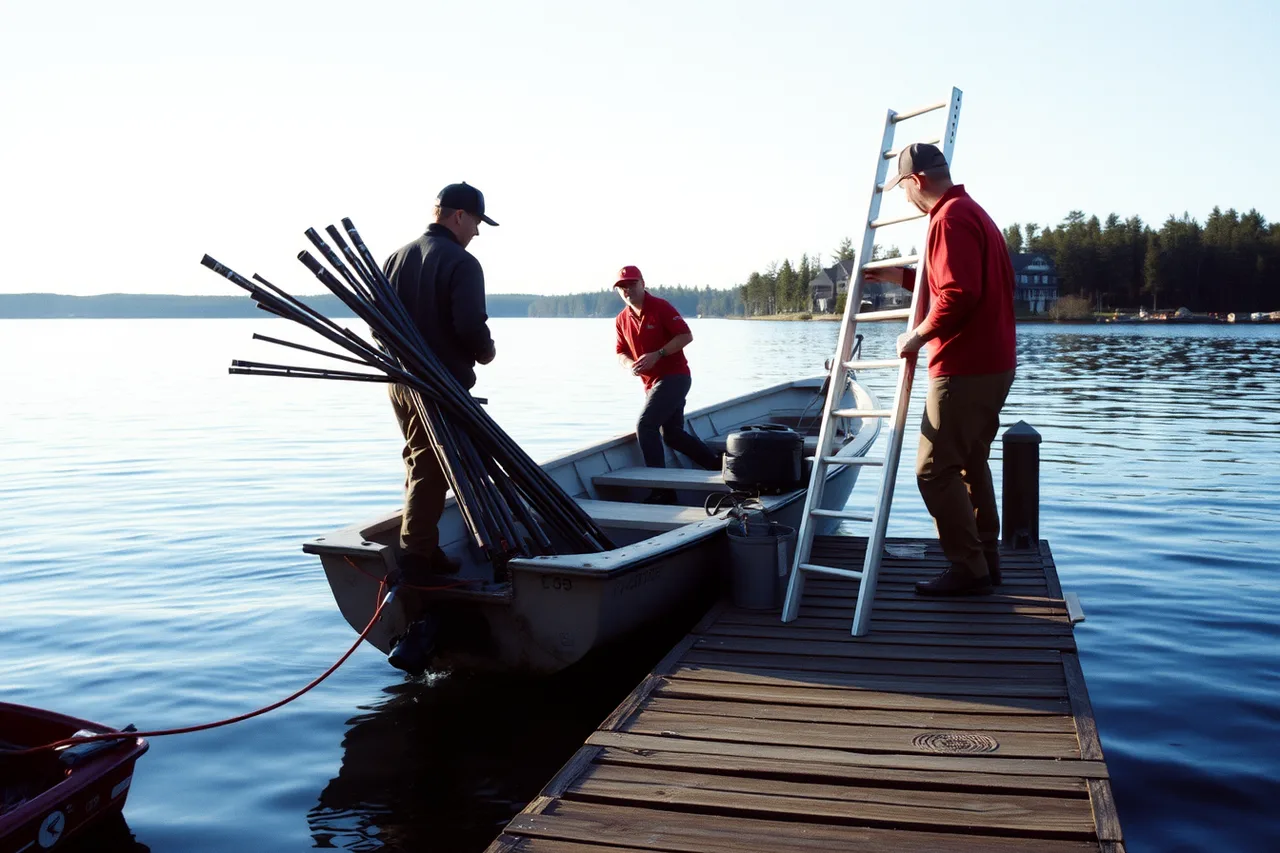
Island cottage chimney access is its own problem. Some properties are boat-only, and you are carrying rods, a vacuum and a ladder across open water.
Dock and boat logistics need a plan. Confirm the dock is in, the water level is workable and the owner has a boat you can use, or plan to launch your own.
Weather can strand a crew on an island for hours. Build that risk into the day, and never book an island job before a mainland job with a hard deadline.
A worked example
A three-flue island cottage on Lake Rosseau, 25 minutes by boat from the nearest launch. Two sweeps, one vacuum, ladders and a tool bag.
Loading and launching takes 40 minutes. The crossing takes 25. Unloading at the dock takes 20. That is nearly two hours before a brush touches a flue.
The sweep itself takes 90 minutes. The return trip repeats the loading, crossing and unloading.
Total on-the-clock time: roughly five hours for one address. Price it as a half day, not as a single sweep. A typical half-day rate for a two-person crew in cottage country is CAD $500 to $700, so the quote should start there.
Pricing models for travel, water access and minimum call-outs
Cottage pricing models in both regions rest on three lines: the sweep itself, the travel, and the access.
Mainland vs island pricing
Mainland cottage
- Pricing basis
- Per flue
- Travel fee
- Zone ring
- Minimum call-out
- Four hours
- Seasonal premium
- Spring opening
Island cottage
- Pricing basis
- Per trip
- Travel fee
- Water surcharge
- Minimum call-out
- Four hours
- Seasonal premium
- Spring opening
A flat per-flue rate works on a mainland cottage close to the road. It fails on an island, where the crossing is the real cost.
Zone pricing is the simplest fix. Draw rings around your depot and set a travel fee per ring, then add a water-access surcharge for anything boat-only.
Seasonal chimney sweep pricing also moves with demand. Spring opening slots are worth more than a mid-August visit, and a same-week booking before the May long weekend is worth more still.
The detail behind these numbers sits in the chimney sweep pricing guide, which is worth reading before you set a rural rate card.
Sample rate structure
| Line item | Basis | Typical range (CAD) | Notes |
|---|---|---|---|
| Standard sweep | Per flue | 150 to 300 | Applies to mainland cottages within the first zone |
| Travel fee | Per zone | 45 to 90 | Zones set by drive time from the depot |
| Water access | Per trip | 90 to 180 | Covers launch, crossing and dock handling |
| Minimum call-out | Per visit | 300 to 450 | Covers drive and access, materials excluded |
| Seasonal premium | Percentage | 10 to 25 percent | Applied to spring opening and pre-holiday bookings |
| Add-ons | Per item | 40 to 150 | Caps, screens, crown repair, camera inspection |
Bundle the add-ons rather than selling them one at a time. A spring opening package with a sweep, a cap check and a written report sells better than three separate line items, and it is easier to schedule. The logic behind that is set out in the guide to service packages.
Booking windows before the May long weekend and after Thanksgiving
The May long weekend is the hard deadline in both regions. Owners want the chimney ready before the first fire of the season. In Muskoka, most calls land in the first two weeks of March. In the Laurentians, the book fills through late March and the first week of April.
Booking windows for cottage sweeps
- FebruaryEmail last year's cottage clients
- AprilOwners call for spring opening
- Early MaySpring schedule should be full
- May long weekendHard deadline for first fire
- After ThanksgivingAutumn sweep window opens
By early May, your spring opening schedule should be full. Anything booked after that is either a premium slot or a problem job.
The second window opens after Thanksgiving. Owners are closing up, renters have gone, and the autumn sweep clears the summer's creosote before the cottage sits empty.
That autumn visit is also when you find the damage winter will make worse. A cracked crown in October is a cheap repair. The same crack in April may mean a rebuild.
Keep a waitlist for both windows. Cancellations are common when the weather turns, and a waitlist fills the gap in minutes.
The Laurentians see more short-term rental traffic, so mid-season calls often come from a guest complaint rather than a planned opening. Both regions reward sweeps who open their books early. A February email to last year's cottage clients fills a May schedule faster than any advertising.
Working with property managers and rental turnover in both regions
Property managers control a large share of the cottage stock in Muskoka and the Laurentians. One contract can mean twenty addresses and a predictable route.

Rental turnover is the angle. Every guest change is a chance the fireplace has been used, and every season end is a chance to sweep before the next booking.
Offer managers a fixed per-cottage rate and a standing schedule. They get predictable costs, and you get a route that fills itself.
Keep the reporting tight. Managers need a written record for owners and insurers, and a photo report per cottage is the easiest way to deliver it.
Be clear about who holds keys, who meets you on site and who approves extra work. Ambiguity here costs more time than the drive.
If you are adding a second region, a manager relationship is often the reason a chimney sweep expansion works rather than stalls.
Crew logistics when the nearest depot is two hours away
A rural route lives or dies on how the van is loaded. There is no supply house around the corner in Muskoka or the Laurentians.
Stock for the whole day. Rods for every flue size, spare brushes, a second vacuum, caps, screws, sealant and a basic tool kit.
Fuel, food and washroom stops are part of the plan, not an afterthought. A two-hour run each way leaves little slack.
Keep the crew small. Two people handle an island job and a mainland job in the same day, and a third rarely earns their seat.
Track drive time as a cost line, not as a rounding error. It is the single largest variable in a rural quote.
A workable two-crew day
One crew takes the mainland addresses clustered around one lake. The second takes the island and boat-only properties.
Both crews start from the same depot, share a morning briefing and carry the same stock list. The first crew finishes on the road, the second finishes on the water.
That split keeps the drive time down and stops a boat job from wrecking a full mainland schedule.